Male Vitality Gummies vs Pills: Which Is Actually Better?
Quick Answer: Are Gummies or Pills Better for Male Vitality?
Neither format is inherently better. Gummies win on adherence, taste, easier swallowing and discretion, so people take them consistently. Pills win on dose density — no sugar, more milligrams per unit. What decides results is a transparent, adequately dosed label, whichever shape it comes in.
- Gummies: easier habit, no water needed, but lower dose ceiling.
- Pills: more actives per serving, zero sugar, but often skipped.
- What matters: a fully split panel dosed near trial levels.
The debate is mostly about the wrong thing
Ask which is better, a vitality gummy or a capsule, and most answers turn into a taste argument. That misses the point. A supplement is a delivery system for a set of active ingredients at particular doses. The gummy or the pill is just the van. Two vans can carry the same cargo — and an empty van of either kind delivers nothing.
So the honest comparison has two layers. First, the format: how likely you are to take it, how much it can physically hold, and what else rides along (sugar, coatings, fillers). Second, the cargo: which actives are on the panel, at what milligrams, and whether those numbers line up with the doses used in human research. Get the second layer right and the first becomes a matter of preference. Get the second layer wrong and the format is irrelevant, because you are buying decoration in a nicer wrapper.
Where gummies genuinely win
Adherence is the big one. The most effective supplement is the one you actually take, and the data on pill-taking is not flattering — adherence to daily regimens routinely slips once the novelty fades. A gummy sidesteps several of the reasons people quit. There is no glass of water to find, no large capsule to force down, and there is a small reward built in: it tastes good, so the brain files it under treat rather than chore. Over a month, the difference between the man who takes his dose 29 days out of 30 and the man who manages 15 is enormous, and no lab assay captures it.
Swallowing is a real barrier for a lot of people. Difficulty swallowing pills is common, and it is not just older adults — plenty of men simply dislike the sensation of a horse-pill capsule. A chewable removes that friction entirely, which is why gummy formats have exploded across the whole supplement aisle, not just men's health.
Faster, easier ingestion. A gummy is chewed and gone in seconds. There is no waiting for a capsule shell to dissolve, no taking it on an empty or full stomach for tolerance. For a daily habit, low friction is the whole game.
Discretion. A men's vitality product is not something everyone wants to explain at the office kitchen or in a shared bathroom cabinet. A gummy reads as an ordinary supplement or even a sweet. That matters more to real buyers than product pages admit.
Where pills genuinely win
Dose density is the honest advantage. A capsule is essentially a container you can pack. It carries no sugar, needs no pectin or gelatin matrix to hold its shape, and does not have to taste of anything. That frees up space for milligrams. If a formula wants to deliver, say, a gram of an amino acid, a capsule (or two) can do it and a single small gummy cannot. When a study dose is large — the arginine and citrulline literature runs in grams, not milligrams — the pill format has room the gummy does not.
No added sugar. Most gummies need some sweetener and a gelling agent to be palatable and stable. A capsule carries none of that. For a man watching added sugar or blood glucose, that is a clean point in the pill's favour, even if the per-serving amount in a good gummy is small.
Stability and simplicity. Capsules tend to be less sensitive to heat and humidity than gummies, which can soften or clump in a hot car or bathroom. Not a dealbreaker, but a genuine practical edge.
The sugar question, handled honestly
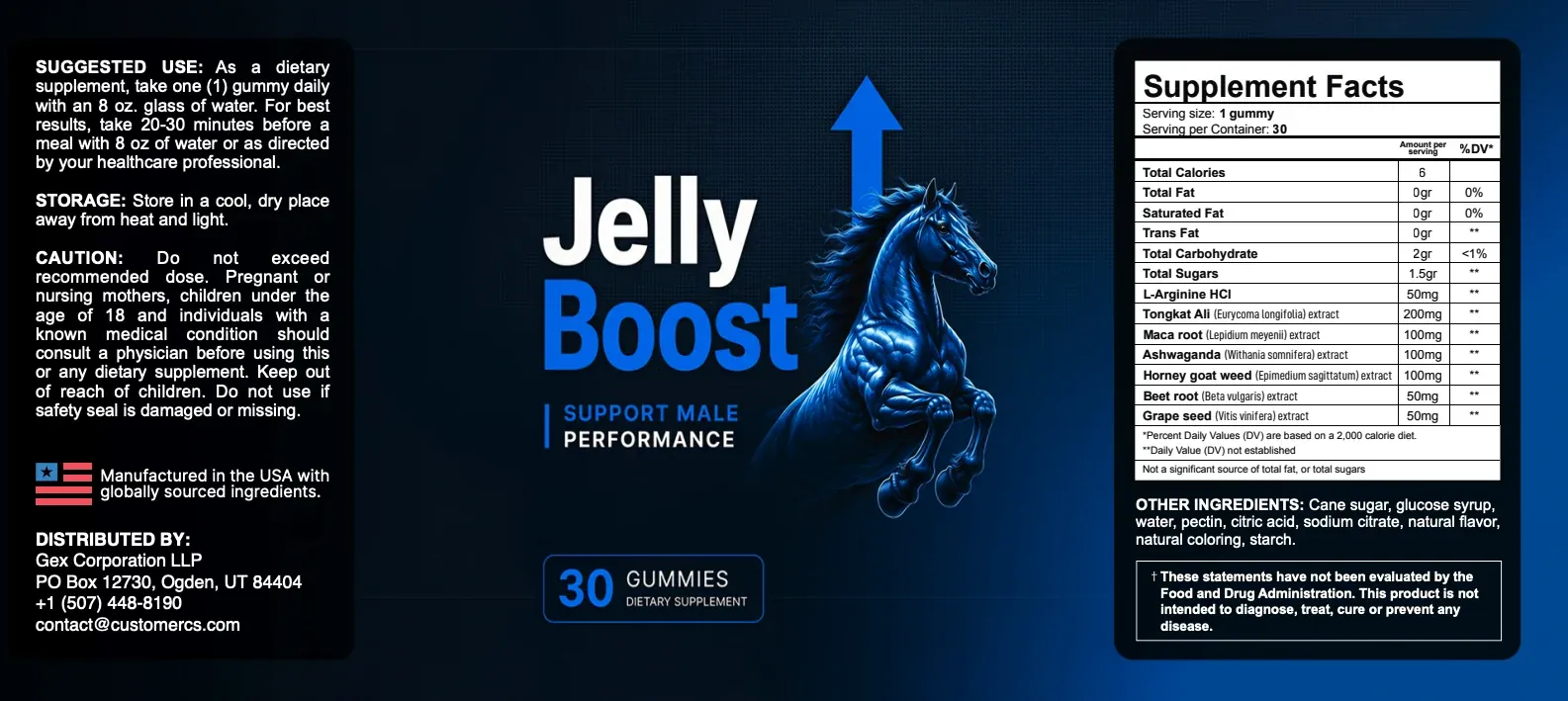
The most common knock on gummies is sugar, so let's put a real number on it rather than hand-waving. JellyBoost declares 1.5 grams of sugar and six calories per gummy. That is roughly a third of a teaspoon. For most men taking one a day, it is nutritionally trivial — less than you would get from a splash of ketchup. It only becomes worth thinking about in two cases: if you are actively managing blood sugar or following a strict low-sugar plan, or if a product asks you to take several gummies a day, in which case the sugar stacks up. Read the serving size, do the multiplication, and decide. If even a third of a teaspoon is off the table for you, that is a legitimate reason to choose a sugar-free capsule instead — and we would rather say that plainly than pretend the trade-off does not exist.
What actually decides the outcome: the label
Here is the part the format debate keeps burying. Whether you pick a gummy or a pill, results come from the actives and their doses. So the buying decision should route through the Supplement Facts panel before it ever reaches the question of chew versus swallow.
Three things separate a formula that can work from one that only looks like it:
- A visible per-ingredient split. If the label groups everything into a single "proprietary blend" with one total, you cannot tell how much of the headline ingredient you are getting. That is a reason to walk, in any format. (We go deeper in how proprietary blends hide the dose.)
- Headline doses near trial ranges. The lead actives should sit in or near the milligram bands used in human studies — not a fraction of them. A gram-scale ingredient dosed in double-digit milligrams is there for the label, not for you.
- Honesty about the supporting cast. A good formula does not pretend its 50 mg amino acid is doing the heavy lifting. It positions the small players as support and lets the properly dosed actives lead.
Our full 90-second method for reading a men's supplement label walks through this with the exact red flags to look for.
How JellyBoost's panel reads through this lens
JellyBoost is a gummy, so it inherits the format's strengths — the habit is easy to keep — and its main limitation, a lower dose ceiling than a packed capsule. What makes it defensible is that it does the label part correctly. There is no proprietary blend. All seven actives are printed with their own milligram figures: Tongkat Ali 200 mg, Maca 100 mg, Ashwagandha 100 mg, Horny Goat Weed 100 mg, L-Arginine HCl 50 mg, Beet Root 50 mg and Grape Seed 50 mg. You can check every number against the research yourself, which is exactly what a proprietary blend is designed to prevent.
That transparency also lets us be candid about the format's ceiling. The L-Arginine at 50 mg is a nudge on the nitric-oxide pathway, not a functional dose — the clinical arginine work uses grams — and a gummy simply cannot carry grams of it. If gram-scale arginine or citrulline is your priority, a dedicated capsule or powder is the honest choice. But for a lead active like Tongkat Ali, 200 mg lands inside the human-trial band, and that is the ingredient the formula is built around. You can see the full breakdown in JellyBoost ingredients explained.
So, which should you buy?
Choose a pill if your priority is maximum dose in the smallest package, you want zero sugar, and you are the kind of person who never forgets a daily capsule. Choose a gummy if you have quietly abandoned every pill regimen you have started, dislike swallowing capsules, want something discreet, and are happy trading a little dose headroom for a habit you will actually keep. For most men, consistency beats theoretical potency, which is why the gummy format keeps winning real-world adherence even when the capsule wins on paper. Just make sure that whichever van you pick is carrying real cargo: a transparent, fully split panel with its lead actives dosed near the levels used in human trials.
Frequently asked
Are gummies as effective as pills?
A well-dosed gummy and a well-dosed pill deliver the same actives to the same body. Effectiveness tracks the ingredients and their doses, not the format. The real advantage of a gummy is that people actually take it every day, and a supplement you skip does nothing at any dose.
Do gummies contain enough active ingredient?
Some do, some do not. A gummy is smaller and shares space with pectin and flavouring, so it holds less than a packed capsule. That is why the panel matters more than the format: read the per-ingredient milligrams and check the headline actives against trial doses before you decide.
Is the sugar in gummies a problem?
For one or two gummies a day the sugar is small - JellyBoost lists 1.5 g per gummy, roughly a third of a teaspoon. That is trivial for most men, but if you are managing blood sugar or cutting added sugar it is worth counting, and it is a genuine point in favour of a sugar-free capsule.
Which is better for men, gummies or pills?
Neither wins outright. Choose a pill if you want the highest possible dose in the smallest package and no sugar. Choose a gummy if taste and habit are what keep you consistent. Either way, buy the one with a transparent, fully split panel dosed near the levels used in human trials.
Related reading
- JellyBoost ingredients explained: all seven actives
- How to read a men's supplement label: 7 red flags
- Proprietary blends: how they hide the dose
- Tongkat Ali dosage: what 200 mg actually buys you
See the current JellyBoost pricing
Full label, all seven actives, and today’s official-store discount.
These statements have not been evaluated by the Food and Drug Administration. This product is not intended to diagnose, treat, cure or prevent any disease. Speak to a qualified healthcare professional before starting any supplement.