Beet Root Nitrates for Blood Flow and Stamina
Quick Answer: Does Beet Root Boost Blood Flow?
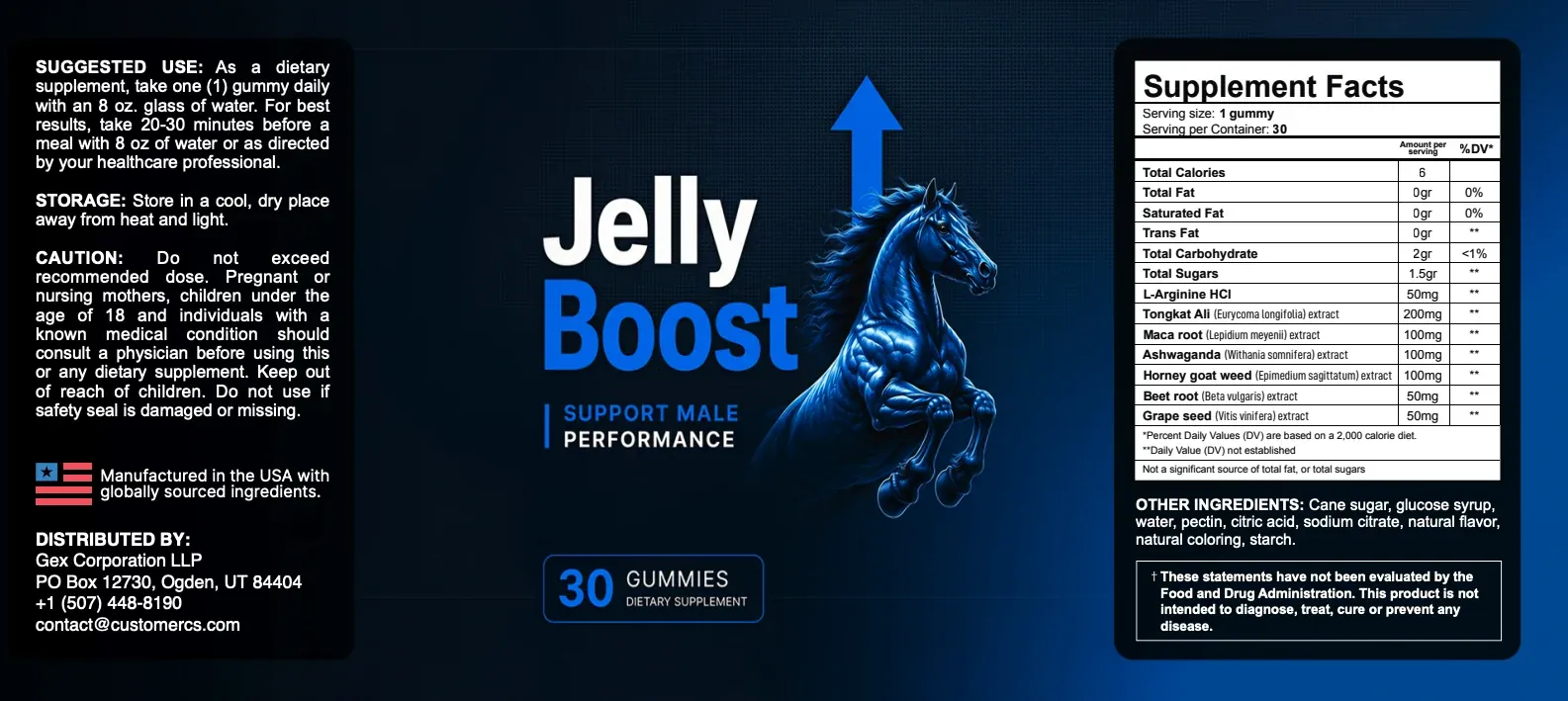
Beet root delivers dietary nitrates that your body converts into nitric oxide — the molecule that relaxes and widens blood vessels. Wider vessels mean more blood flow to working muscle and better endurance. The catch: measurable effects come from far larger nitrate doses than the 50 mg of root powder on the JellyBoost panel.
- The mechanism: nitrate → nitrite → nitric oxide → vasodilation.
- On the label: beet root 50 mg, one of three actives feeding that pathway.
- The catch: nitrate trials use beet juice, not 50 mg of powder.

What beet root actually brings to a men's formula
Beet root (Beta vulgaris) earns its place in vitality formulas for one reason: it is one of the richest dietary sources of inorganic nitrate. The nitrate itself is inert. What matters is the chain reaction it starts once it reaches your saliva and bloodstream, ending in nitric oxide — the small signalling molecule that tells the smooth muscle lining your arteries to relax and widen.
That widening is called vasodilation, and it is the whole game here. Wider vessels carry more oxygen-rich blood to muscle, brain and everywhere else the demand rises. For a supplement aimed at stamina, energy and circulation, a reliable nitric-oxide donor is a sensible ingredient to reach for. The honest question is never whether the mechanism is real — it plainly is — but whether the amount on the label is enough to drive it.
The nitrate-to-nitric-oxide pathway, step by step
Your body makes nitric oxide by two routes. The first is the classic enzyme pathway, where an enzyme called nitric oxide synthase builds it from the amino acid L-arginine. The second is the dietary route, and this is the one beet root feeds. It works in a relay:
- You eat nitrate from beet root or leafy greens.
- Friendly bacteria on your tongue reduce a portion of that nitrate to nitrite.
- In the acidic stomach and the circulation, nitrite is converted into nitric oxide.
This relay matters because it is independent of the enzyme route and keeps working even when oxygen is low — exactly the conditions inside hard-working muscle. It is also why an antibacterial mouthwash can blunt the effect of beet juice: kill the tongue bacteria and you break step two. It also explains why beet root and L-arginine appear together on so many labels. They feed the same end product from two different directions, which is genuinely complementary rather than redundant.
What the research shows on blood flow and stamina
Beetroot is one of the better-studied sports-nutrition ingredients, and the pattern is consistent. Concentrated beetroot juice has repeatedly lowered resting blood pressure by a few points in healthy adults, a change that reflects easier flow through relaxed vessels. In exercise trials, nitrate supplementation has reduced the oxygen cost of steady effort — meaning you can hold a given pace for slightly less physiological strain — and improved time-to-exhaustion in some endurance protocols.
The effects are real but measured, not miraculous. They tend to show up most in recreational rather than elite athletes, and the size of the benefit tracks the dose of nitrate. That last point is the crucial one for reading a label honestly, and it is where the fine print starts to matter.
How much beet root do you actually need?
Here is the detail the marketing rarely spells out: the research is dosed by nitrate content, not by the weight of beet root. Studies that shift blood pressure and endurance typically supply somewhere around 300 to 600 mg of nitrate. In practical terms that is roughly one to two cups of beetroot juice, or a single concentrated "shot" designed to hit that number.
A raw beet root powder is far more dilute than a standardised juice concentrate. So a 50 mg dose of beet root powder — the amount on the JellyBoost panel — supplies only a small fraction of the nitrate used in those trials. That does not make it pointless. It makes it a contributor rather than the headline act: a modest top-up to the nitric-oxide pathway that sits alongside the L-arginine on the same label, not a substitute for a proper nitrate dose before a race.
If maximal endurance is your specific goal, the practical move is food and juice: beetroot, arugula, spinach and other nitrate-dense greens in real serving sizes, timed a couple of hours before you train. A gummy's worth of beet root is better read as everyday vascular support than as a pre-workout ergogenic.
The label quirk worth knowing
There is a small but telling detail on JellyBoost specifically. Beet root is printed on the Supplement Facts panel at 50 mg, but it is absent from the official sales copy. The marketing describes six actives; the panel lists seven. Nothing sinister is going on — if anything it is the reverse of the usual trick, where a brand hypes an ingredient that is barely present. Here an ingredient is quietly present but not hyped.
The lesson generalises: when you are comparing two products, read the panel, not the pitch. The Supplement Facts box is the regulated, standardised part of the package. The sales page is not. A mismatch between the two — in either direction — tells you which document to trust.
Beet root and erections: the honest version
It is a fair question, because erections are fundamentally a blood-flow event and nitric oxide is the central signal that starts them. Anything that supports the nitric-oxide pathway is therefore plausible in theory. But plausible is not proven. There is no strong human trial showing beet root on its own improves erectile function, and it would be dishonest to imply otherwise. The reasonable framing is general vascular support — keeping the plumbing healthy — rather than a targeted fix. If erections are a persistent concern, that is a conversation for a doctor, not a gummy.
How long does it take to work?
For the acute effects — blood pressure, exercise economy — nitrate from beetroot peaks in the blood roughly two to three hours after a dose. That is precisely why endurance athletes take their beet juice a few hours before an event rather than the moment before. Any longer-term benefit to vascular health is a slower story: it builds over weeks of consistent nitrate intake as part of a sensible diet, and it fades if you stop. There is no version of beet root that works once and stays worked.
Where beet root fits in the bigger picture
Treat beet root as one lever among several. It pairs naturally with L-arginine on the nitric-oxide pathway, and both sit downstream of the basics that move blood flow far more than any single ingredient: regular cardiovascular exercise, not smoking, keeping blood pressure and blood sugar in range, and sleeping enough. A supplement's beet root content is a small, sensible nudge on a system you mostly control with lifestyle. Read it that way and it is a reasonable inclusion. Read it as a stamina miracle and the label will disappoint you.
Frequently asked
Does beet root improve blood flow?
Yes, through nitric oxide. Beet root is rich in dietary nitrate, which the body converts step by step into nitric oxide, the molecule that relaxes and widens blood vessels. In controlled studies, nitrate-rich beet juice has lowered blood pressure and improved blood flow to working muscle. The effect is dose-dependent, so a small amount of root powder is not the same as a full serving of concentrated juice.
How much beetroot do you need for nitric oxide?
The research uses the amount of nitrate, not the weight of the root. Studies that move blood pressure and endurance typically supply roughly 300 to 600 mg of nitrate, which is about one to two cups of beetroot juice or a concentrated shot. A 50 mg dose of beet root powder, as listed on the JellyBoost panel, supplies only a fraction of that and works best as one nudge on the pathway rather than a full dose.
Does beet root help erections?
Only indirectly, and it has not been proven for that use. Erections depend on healthy blood flow, and nitric oxide is central to the process, so anything that supports the nitric-oxide pathway is plausible in theory. There is no strong human trial showing beet root alone improves erections, so treat it as general vascular support, not a treatment.
How long does beetroot take to work?
For blood pressure and exercise effects, nitrate from beetroot peaks in the blood about two to three hours after a dose, which is why athletes take it before training. Any longer-term benefit to vascular health builds over weeks of consistent intake alongside a sensible diet, not from a single serving.
Related reading
- JellyBoost ingredients explained: the full label, one page
- L-Arginine and nitric oxide: why the dose decides everything
- How to improve blood flow for erections naturally
- Stamina and energy for men over 40
See the current JellyBoost pricing
Full label, all seven actives, and today’s official-store discount.
These statements have not been evaluated by the Food and Drug Administration. This product is not intended to diagnose, treat, cure or prevent any disease. Speak to a qualified healthcare professional before starting any supplement.